



There’s nothing overnight about Anjum Batra’s journey; only a slow, deliberate build shaped by instinct, accident and survival. From a mischievous schoolboy who discovered performance almost by chance in eighth standard, to a theatre-trained actor from Panjab University inspired by Gurdas Maan, Batra’s path has been anything but linear. He made an early screen appearance in Anurag Kashyap’s Dev.D (2009), spent over a decade honing his craft on television through shows like Crime Patrol and Code Red, and quietly balanced survival in Mumbai with small but steady film roles across projects like Simmba (2018), Jersey (2022), and ’83 (2023).
That persistence is now finding visibility. With Amar Singh Chamkila (2024) and the widely watched Netflix series Maamla Legal Hai, a courtroom comedy set in a bustling district court, directed by Rahul Pandey and featuring actors like Ravi Kishan, Naila Grewal and Anant V Joshi, Batra has moved from being a familiar face to a performer audiences are beginning to place and appreciate. The legal comedy drama series has struck a chord for its humour and everyday realism, with Batra’s Mintu adding to its lived-in charm. In an exclusive interview with The Movie Mail, the actor opens up about finding his voice, navigating the long road through television, and the quiet discipline behind his craft.
Edited excerpts:
It’s been two seasons living with Mintu. How would you describe your relationship with the character?
A. As an actor, I’ve spent a lot of time with him. His voice and mannerisms belong to Mintu, but they come through me. Over time, there’s an overlap. Somewhere I am him, and he is me.
Did you always want to be an actor?
A. Not really. I wasn’t obsessed with acting as a child. I was mischievous, though, not as notorious as I was made out to be, and often blamed for things around me, which made me slightly rebellious. I started losing interest in studies despite being a good student.
Things shifted in class 8, when I moved schools and teachers noticed talents I didn’t know I had. I performed bhangra on stage, sang, and for the first time, felt seen. That applause changed something. I began to enjoy performing.
I grew up watching Gurdas Maan and wanted to be like him. I moved towards music and theatre, and discovered the theatre department at Punjab University, which has produced actors like Yashpal Sharma, Kirron Kher and Mahie Gill. I formally studied acting, deepened my understanding of performance, and eventually made my debut with Dev.D.
Honestly, I first wanted to be a stage performer, a singer doing live shows. Acting, as a full-time career, came later.
You worked on television for over a decade before gaining wider recognition through films and OTT. Do TV actors miss out on due credit?
A. To an extent, yes. There’s a perception issue. TV actors are often viewed differently from film or OTT actors. But a show like Crime Patrol running for years proves its value. It means people are watching and engaging. There are excellent actors working with minimal resources, delivering consistently under tight budgets.
At the same time, films and OTT offer wider visibility and a certain industry validation. That said, things are changing. Many actors from television are now doing strong work across platforms and earning respect.
Why do some actors still avoid television?
A. It’s largely (because of) perception. After Dev.D, I was advised not to do TV so that I wouldn’t be typecast. But survival in Mumbai was important. I had to earn. I continued doing TV while also taking small film roles, thanks to my association with Mukesh Chhabra. You manage what you can to sustain yourself, and television has helped many actors do that. Also, when someone like Salman Khan is hosting a TV show, it shows how powerful the medium is.
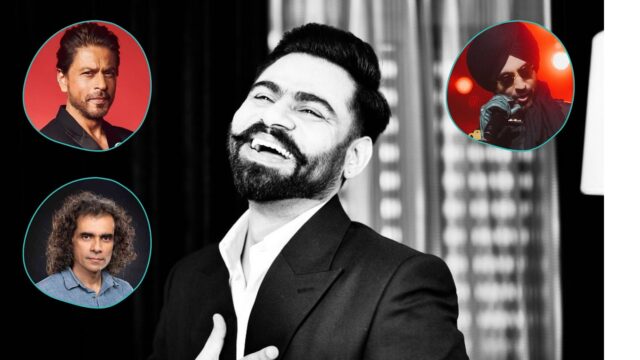
You met Shah Rukh Khan at Mannat during Jab Harry Met Sejal (2017). What do you remember?
A. (Laughs) It was special. I knew Imtiaz Ali through Mukesh Chhabra. He asked me to help add Punjabi authenticity to the dialogues since the character was from Punjab. Initially, I didn’t even know it was for Shah Rukh sir but then I was told I’d be meeting him.
We met late at night at Mannat, and the three of us had a long conversation. He’s incredibly warm and generous. Interestingly, when Imtiaz later saw my audition for Chamkila, he didn’t recognise me because my look had changed so much.
You’ve observed stars like Ranveer Singh, Diljit Dosanjh and Shah Rukh Khan closely. What stands out?
A. Their preparation and discipline. They don’t just know their lines, they know everyone’s lines. There’s immense hard work behind what we see, along with humility. Stardom like that comes from consistency.
As your popularity grows, what’s one celebrity habit that you’ll avoid?
A. Calling the paparazzi and then pretending to be surprised. (Laughs) That performative “Oh, you’re here?” moment. I find it quite funny. I’d rather keep it real.